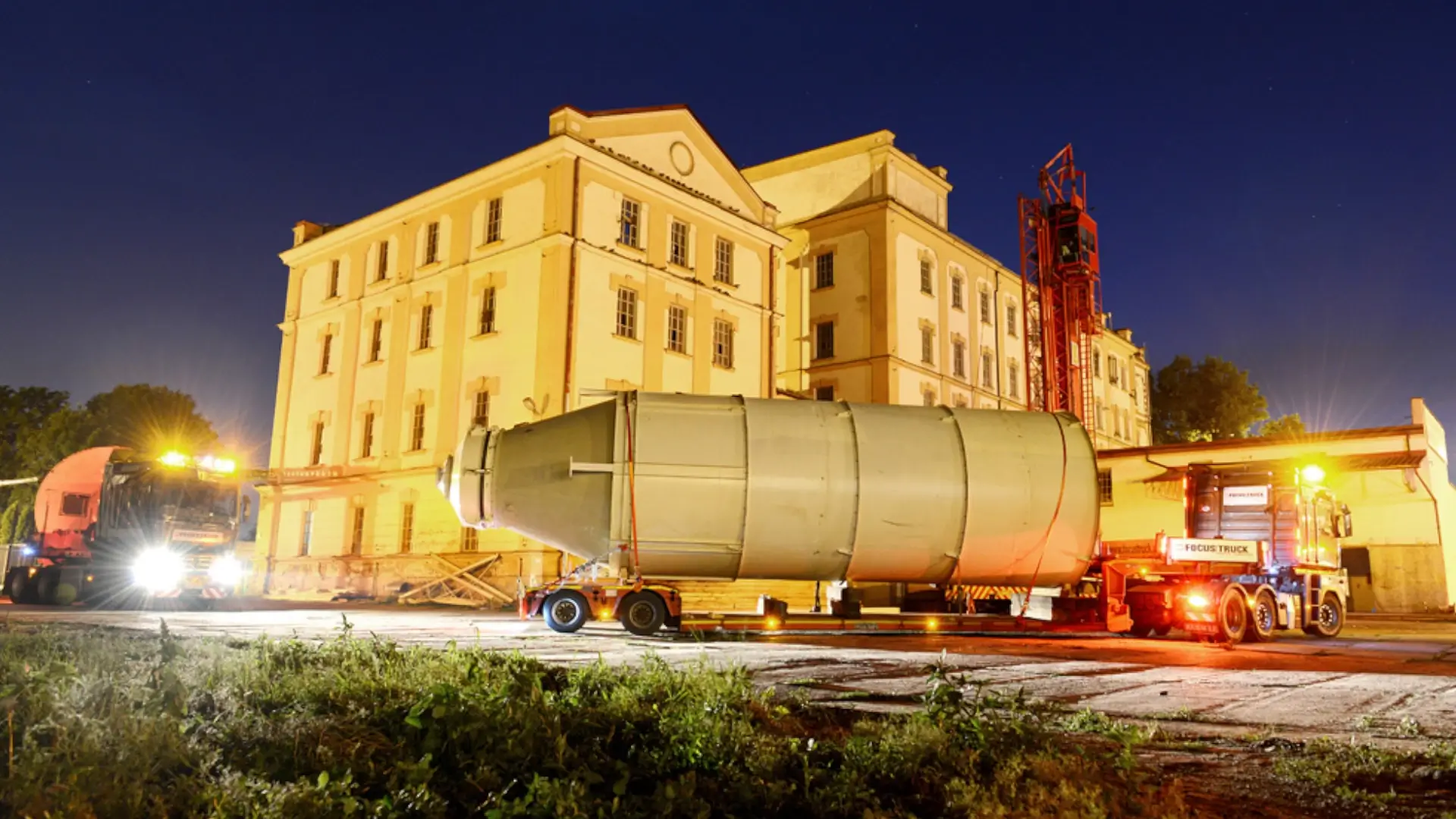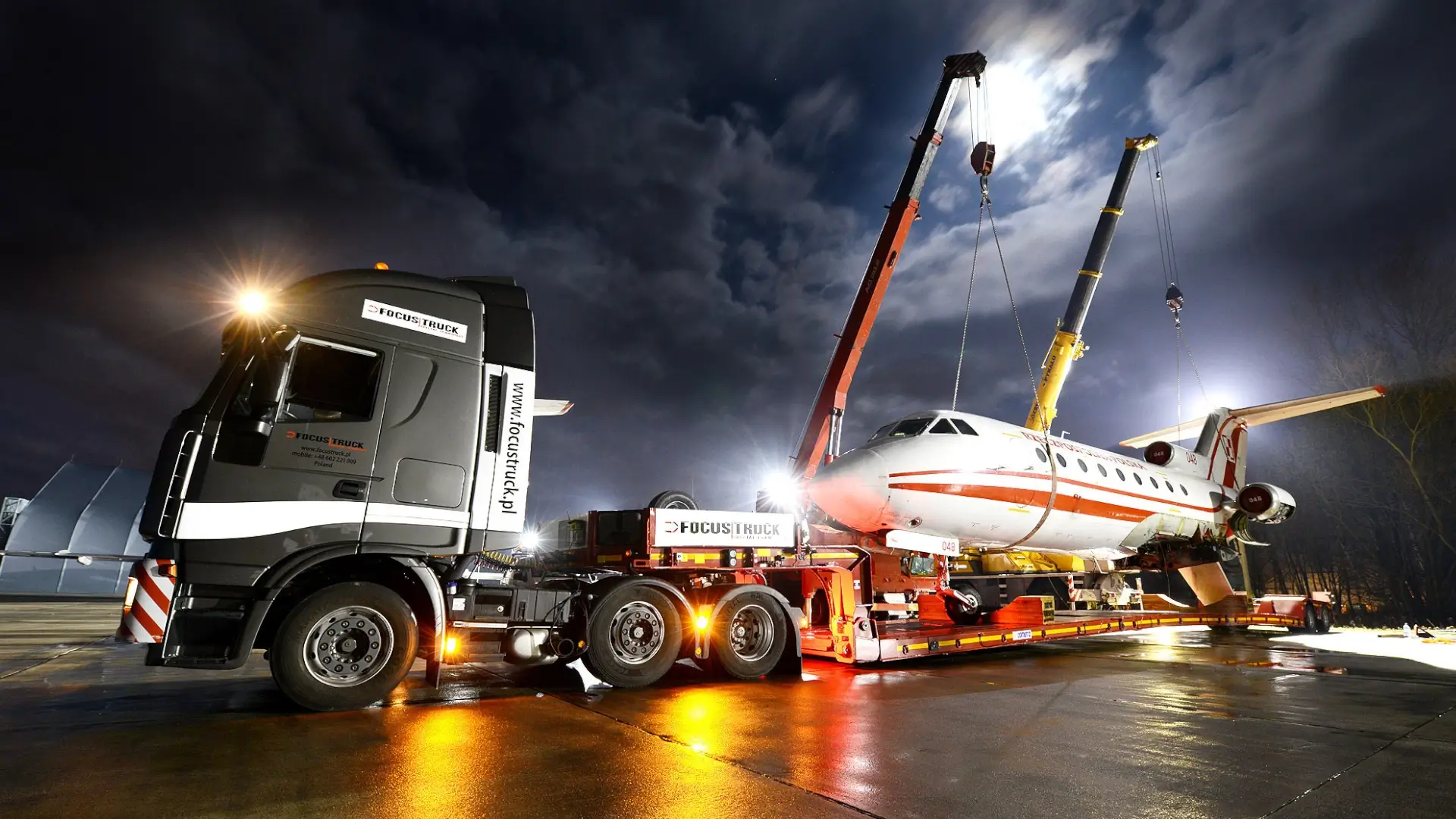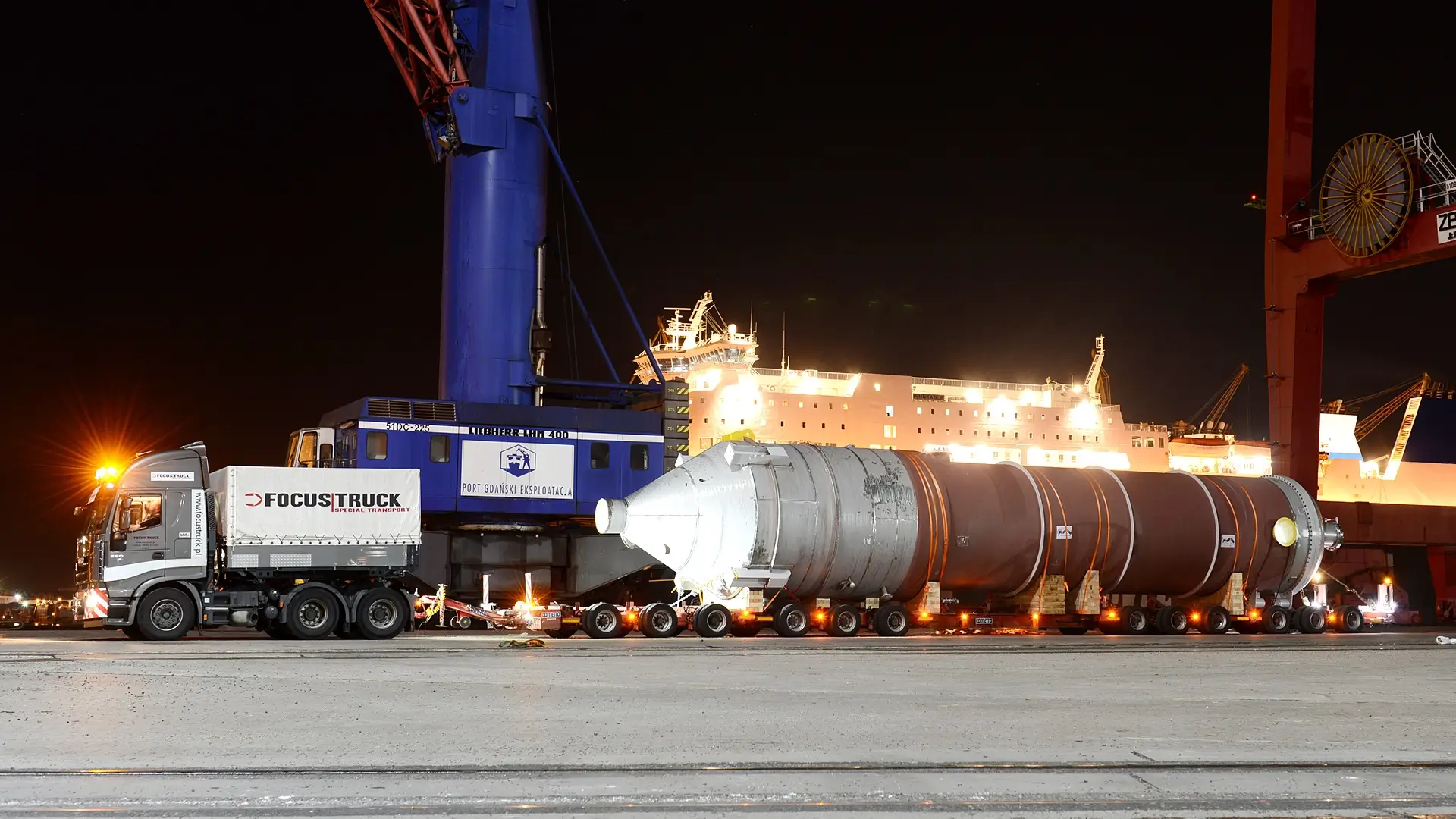
Interview with the founders of Focus Truck Special Transport, published in the monthly magazine “Samochody Specjalne”. How do they run their transport business and how do they choose their equipment?
With the founders of the Focus Truck company – Dominic and Michael Woch we talk about their ideas about running the oversized business and how they select their vehicles.
Universal semi‑trailer: the lightest and the lowest
Focus Truck is a relatively young, yet dynamically developing company specializing in the transport of oversized loads. We talk with the company’s founders – Dominik and Michał Woch – about their concept for the oversize business and the way they select vehicles for this purpose.
Focus Truck, established in 2007, specialises in domestic and international abnormal load transport. The company operates combinations tailored to handle a full spectrum of cargo, such as construction and agricultural machinery, components of industrial and building structures and installations, tanks, chemical reactors, yachts, and boats. Focus Truck also carries out relocations of production plants and transports cargo that is not initially prepared for shipment and requires individually adapted transport configurations. The company focuses on transport within Europe along the West–East and East–West corridors and performs oversized transports in countries such as Belarus, Ukraine, and Russia.
Focus Truck currently operates a fleet of 10 semi-trailers. The two oldest are 3‑axle lowbed semi‑trailers (semi‑light type) from Pacton, without extension, with a deck height of just 750 mm. The remaining units are three MultiMAX trailers from Faymonville and five Cometto trailers – including 2‑axle deep‑well (tieffbett) trailers for cargo with exceptionally large height and weights up to 40 tonnes, and 5‑axle double‑extendable units suitable for particularly long loads (up to 30 m) that are not among the heaviest. The trailers are operated by 3‑axle tractor units Volvo FH, Renault Magnum, or IVECO Stralis, equipped with fleet management systems and GPS positioning.
What determines the choice of trailer manufacturer?
Dominik Woch: In fact, several factors influence our final choice. It is not just the product itself; it is also pricing, business relationships, how much the manufacturer cares about having you as a customer, to what extent they want and are able to meet your requirements and wishes regarding the equipment, plus service issues, access to spare parts, and so on. So when we talk about trailers that are simpler to operate, we prefer Faymonville, whereas for more sophisticated equipment with hydraulic systems we decided to use Cometto trailers.
It would be too much of a simplification to say that our fleet is suited to everything, but as a carrier at our current stage of development, we try to keep our equipment as universal as possible – which is not easy – so that we can carry out transport tasks effectively in every corner of Europe.
When hauling abnormal loads, do you grow into a specific vehicle, or do you rather look for cargo for specific vehicles?
Michał Woch: We are first‑generation hauliers, so we are building our experience on the go. Every next step is a combination of the theoretical knowledge we have acquired and the practical experience we keep adding. As a result, every next vehicle we order is better than the previous one. We analyse the situation and buy the trailer for which we anticipate high demand for the services that can be provided with that piece of equipment. Then, with each subsequent similar vehicle, we introduce improvements and modifications, and it becomes even better. Good solutions are repeated.
What does Focus Truck actually haul?
Dominik Woch: We have defined a specialisation called abnormal load transport, but within that scope we aim to be as universal as possible. We want to be able to handle 80 percent of the jobs available on the market, to be capable – both technically and logistically – of “grasping” the majority of the assignments. The remaining 20 percent that we cannot move, mainly due to technical constraints, is a segment reserved for carriers who dominate this niche.
What would an ideal trailer for abnormal transport look like? Does such a trailer exist?
Dominik Woch: A trailer should be as light and as low as possible – if necessary, with low‑profile tyres. Suspension travel is also important – the greater the range, the better – and it matters how far down from the driving position you can lower the deck, because this can be crucial on route when passing under bridges or viaducts.otrucking+1
The quality of the equipment is equally important, for example the quality of the steel used to build the trailer. We must be sure that these vehicles will withstand intensive use. Knowing that high‑strength steel has been applied, we can operate the trailer intensively at loads close to the maximum.
What else determines equipment quality?
Michał Woch: If you buy universal equipment and do not yet have signed contracts for specific cargo, you need to align several key elements. As we said – the vehicle should be as light and as low as possible, but you cannot go overboard with the price by buying an overly expensive trailer, because it simply will not pay for itself. Clients do not pay attention to what their cargo is carried on and what brands of tractors or trailers are used. Unfortunately, in today’s transport market it is the price and the internet that rule – at any moment a customer can check and compare offers online.
Dominik Woch: The equipment must be good and offer maximum capabilities, but it still cannot be just any trailer. As the price increases, so does the quality, and here the material – the steel – plays the decisive role. We can load 55 tonnes, and it almost does not matter whether that weight is spread over 3, 6, or 9 metres, whether the 55 tonnes sits near the outer edges of the trailer or on its spine. The trailer can withstand such loads regardless of how the cargo is positioned and what forces it generates. And we know of cases where, under load – not even at the maximum payload – the vehicle simply “folded up”.
How important are accessories and all additional equipment?
Michał Woch: These are extremely expensive “toys”. A set of two pairs of extensions with adapters for a 2‑axle deep‑well trailer can cost as much as a standard‑equipped “bare” trailer. Additional equipment – adapters, extensions, extra axle bogies – are accessories that only the top carriers own, and they often provide a competitive edge. Having unique transport capabilities that differ from standard solutions allows you to maintain your rates and face less competition in the market.
In this business, is price a measure of quality?
Dominik Woch: Price is a measure of quality, but it is a bit like with passenger cars. Once you cross a certain price threshold – say 200,000 zlotys – you know you will not find poor‑quality vehicles there. Yet there are huge price differences despite comparable performance or equipment. You pay for the brand and for the image. It is the same with trailers. In our choices we focus on quality at a reasonable price. Even within a single brand, there are options: for example, we have a 5‑axle MultiMAX trailer that can carry 55‑tonne wide machines – in short, a lot of different loads – and the alternative could be a VarioMAX 2+4 trailer that is nearly three times more expensive but offers only 10 tonnes more payload.
So not all trailers are created equal?
Dominik Woch: Besides the technical characteristics we have already mentioned, equipment must always be competitive. We started with domestic transport and a single 3‑axle lowbed semi‑trailer of the semi type – and there are certainly more than a thousand such trailers in Poland. We saw that there was huge competition on the market. It is no surprise that we tried to ensure that we always had something in our offer that increased our competitiveness – even with that simple trailer. We added outriggers, which already eliminated part of our competitors, then started to operate that trailer internationally, which again improved our chances compared to other carriers. Finally, we lowered it by 15 cm by changing the tyres and airbags, and we replaced the tractor unit with a low‑deck model with large fuel tanks. Now we have a super‑low, lightweight, non‑extendable 3‑axle trailer with which we carry a huge number of loads. This is how a simple tri‑axle unit became highly competitive.
When buying subsequent trailers, we always paid attention to the tare‑to‑payload ratio. When configuring a vehicle, we aimed to make it a few tonnes lighter than a comparable trailer with the same number of axles but, for example, hydraulic suspension and large ramps. A lighter trailer and lighter combination also means different permits – our combinations fit into the cheaper category below 60 tonnes gross. This has a massive impact, especially on Eastern routes – for example, in Ukraine a permit for a 59‑tonne combination costs, depending on the distance, say 1,000 euros, whereas for 61 tonnes it is already 4,000 euros for the same route. You must be competitive and economical. The days when fuel costs did not matter in abnormal transport are long gone. There are fewer and fewer projects where costs are irrelevant. Oversized transport also has to be efficient.
Is there a threshold beyond which only true professionals operate?
Michał Woch: From time to time, non‑standard jobs appear that require developing a complete, bespoke concept. Sometimes we work at 100–110 percent of our capabilities, organising the entire operation and still hiring subcontractors, for example with modular trailers. Many carriers with similar technical capabilities do not take on such tasks because they are very high‑responsibility jobs, logistically complex, and they require significant upfront costs. We have several such projects we are genuinely proud of.
Dominik Woch: Besides observing what is happening on the market and having good equipment, you also have to know what can be done with that equipment. And you cannot be afraid to use it right up to the proverbial limits of its capabilities. Sometimes, by taking a calculated risk, you can gain more. It may sound cliché, but we strive to meet our clients’ needs in a truly comprehensive way. We have already managed transport of cargo to Egypt, even though our own vehicles completed their part of the work in the port of Gdynia – but we were responsible for the entire operation.
What is the “cream” of abnormal transport?
Michał Woch: The most spectacular transports on modular combinations with a dozen or several dozen axle lines occur very rarely. In Poland, in my opinion, the top tier of abnormal carriers is represented by those who can offer the broadest range of services.
Dominik Woch: The most spectacular oversized transports now usually take place in developing countries; in Europe demand for such projects is low. It is crowded and dense here, and Europe is so industrialised that virtually everything has already been built. Modernisation works are carried out on a smaller scale and often with a trend towards miniaturisation. The largest European companies in this industry, such as Italian Fagioli or Dutch Mammoet, now operate mainly outside Europe, successfully leveraging their vast technological capabilities and, above all, their know‑how in abnormal transport.
Where does the equipment and its capabilities end, and where does the human factor begin?
Dominik Woch: Equipment and people are two equal pillars of this business. If you do not have the right hardware, you cannot do anything, but what you are able to achieve with that hardware is just as important. Sometimes we see companies with trailers far better than ours, but they use them for simple loads and only on domestic routes.
A driver hauling abnormal loads must be a bit of a “transport bandit” – in the positive sense of the term. They need to be brave, mentally resilient, and at the same time responsible and thoughtful. In practice, they should have all the traits of an ideal driver and at least somewhat enjoy what they do. I must admit, it is difficult to find such people.
So is logistics where most of the action happens?
Dominik Woch: Yes, definitely. There is much more planning involved. Above all, it is direct relationships with clients that matter – complex loads are not typical forwarding jobs. While in mass freight on standard trailers forwarding works very well, in abnormal transport it can be an unnecessary link between the client and the carrier. An oversized carrier must maintain strong direct contact with the customer, if only to explain precisely how their cargo will be transported. And you have to actively fight for that customer.
Thank you very much for the interview.